

Fractional CFOs live in a very specific reality.
You carry the responsibility of a CFO, but across several businesses at once. Each client expects clear insight, sound governance and practical guidance, often on a part‑time budget and with limited internal support.
Seeing what needs to change in a business is not usually the hard part. The real constraint is having the time, structure and reliable data to support those decisions across multiple clients, month after month.
This is where a managed Business Intelligence service like Insight BI can make a difference. Not as another tool to learn and maintain, but as a way to lift the standard of reporting for every client you serve, without building a BI team of your own.
The Reality for Most Fractional CFOs
If you work as a Fractional CFO, this may feel familiar.
You step into a business and find an ERP that is underused, a network of spreadsheets that acts as the real reporting system, and a few “temporary” fixes that became permanent. Another client has tidy financials and a strong accountant, but very limited visibility for the board. A third has grown fast and now runs on a mix of systems, shared drives and emailed reports.
The details shift, but a few things stay constant. You are expected to bring board‑level clarity on cash flow, profitability, risk and performance. You quickly become the person who understands how the ERP exports tie into the spreadsheets and manual adjustments. And you almost never have a full BI team backing you.
As your client base grows, the number of reporting processes you support grows with it. That overhead does not scale well. At some point, your capacity is limited less by demand and more by the amount of manual reporting you can absorb.
Insight BI was built with exactly this pattern in mind. It is designed to give finance leaders, including Fractional CFOs, a way to stabilise and improve reporting without having to assemble a separate BI function in every client.

Why Traditional BI Often Misses the Mark
When people hear “Business Intelligence”, they often think of large projects, internal BI teams and long implementation cycles. That picture does not fit comfortably into the world of a Fractional CFO.
Many of your clients are cautious about big BI initiatives. They worry about cost, disruption and whether they have the skills to keep a new platform running. They already feel stretched across multiple systems.
Even when a BI tool is bought, the responsibility for keeping it aligned with reality often drifts back to finance. In practice, that can mean back to you.
What you need is different. You need a way to improve insight that respects the systems your clients already use, that does not turn you into a full‑time BI manager, and that can be applied across multiple clients in a repeatable way.
That is the space where a managed BI service like Insight BI fits.
What Managed BI with Insight BI Looks Like
Managed BI is a service, not just a set of tools. Insight BI combines a platform with the way data is structured and the way reporting is looked after over time.
Viewed from a Fractional CFO’s side, Insight BI usually works like this.
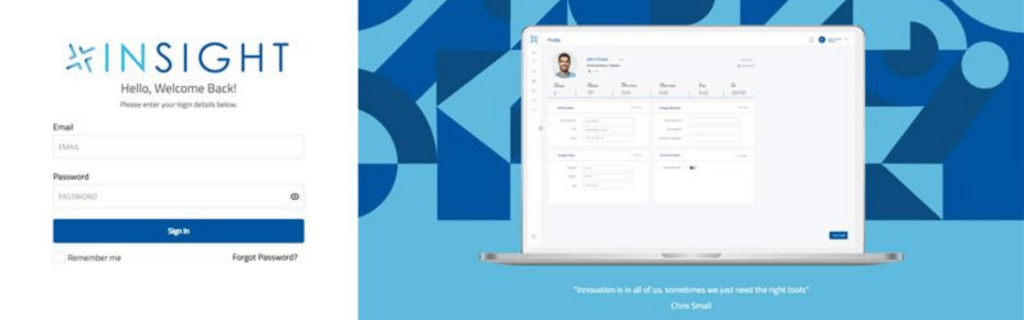
Your clients keep the systems they rely on today. That might be an ERP, an accounting package, line‑of‑business tools and some key spreadsheets. Insight BI connects to these sources and extracts the relevant data in a controlled, repeatable way. A data model is built around agreed definitions and calculations. On top of that model, Insight BI presents dashboards and reports that reflect how the business is actually managed, not just how data happens to be stored.
That reporting layer does not stand still. Metrics are refined, structures are adjusted and reporting is kept in step with changes in the organisation. Insight BI behaves as a managed service that evolves with the business, rather than a fixed set of charts.
You still decide what matters for each client. You still interpret what the numbers mean in the boardroom. But you no longer carry all of the work of stitching reports together, client by client, month after month. Insight BI becomes the stable foundation that your advisory work can rest on.
How Insight BI Helps You Deliver More Value
The test is simple. Does Insight BI allow you to deliver more value to each client without growing a team around you?
In practice, there are three areas where it tends to make a noticeable difference.
A clearer, repeatable view for every client
Most of your clients want a clear picture of performance that the board can understand and trust. They want to see how the business is doing across branches, products or regions, and they want to see it in time to act.
With Insight BI in place, that view is not rebuilt from scratch every reporting cycle. Once the model and dashboards are set up for a client, regular packs can be generated from a stable process. You arrive at meetings with a consistent Insight BI view of the business that everyone recognises, instead of a set of last‑minute spreadsheets.
That consistency not only saves time, it also strengthens confidence in your numbers.
Less dependence on spreadsheet heroes
Many organisations depend heavily on one or two “spreadsheet heroes”. These individuals understand how the complex files work, where every link goes and which manual tweaks are needed. When they are unavailable, everyone feels exposed.
Insight BI helps move critical logic out of individual workbooks and into a shared, transparent model. Definitions and calculations are visible and testable. You and your clients can see how key figures are built up, rather than relying on hidden formulas.
Reporting becomes more resilient, and less tied to single people. As the advisor who helped to put that structure in place, you are associated with that improvement.
Faster, more confident answers
Clients regularly raise questions that do not fit neatly into a standard report. A board member wants to understand exposure to a specific risk. A CEO asks why margin is drifting in one part of the business. A shareholder wants to know which key customers are below target.
In a spreadsheet‑heavy environment, these questions often turn into small projects. With Insight BI, many of them can be explored on screen by adjusting filters, drilling into detail or opening focused views. You stay in the same trusted environment, rather than starting from a blank file.
For your clients, the experience is simpler. Your answers are quicker, clearer and easier to verify.
How to Know You’re Ready for a Managed Approach
You don’t need a complex maturity model to see whether you’re at this point. A few honest reflections are usually enough.
If removing one or two key people would cause your reporting to fall over, your risk is high. If executive meetings routinely begin by sorting out which version of the numbers to trust, your standard of insight is too low. If you’ve invested in tools but Excel is still the engine behind your critical reports, technology hasn’t solved your problem, it’s sitting around it.
In situations like these, another platform will only add another layer. What you need is a better way of managing the insight process end to end.
That starts with a different kind of conversation: one that looks at where reports come from, where they get stuck, who carries the burden and what it costs when leadership doesn’t have a clear, timely view of the business.
You probably don’t need more data. You need more from the data you already have and that only happens when reporting is treated as a managed, ongoing service rather than an afterthought.

A Different Way to Scale Your Impact
Fractional CFO work rests on trust and clarity. Clients rely on you to make sense of complexity, to frame choices and to stand behind the numbers when decisions are taken.
Insight BI does not replace that role. What it does is give you a stronger, more stable reporting foundation underneath it.
You can lift the reporting standard for each client. You can reduce their dependence on fragile spreadsheets and single points of failure. You can regain hours that would otherwise disappear into manual compilation. And you can do all of this without building a large team of analysts and developers around you.
If this feels close to your reality as a Fractional CFO, it may be worth seeing what a managed BI layer with Insight BI could look like in your world. Insight BI connects to the systems you already use and gives you a reporting foundation you can rely on with every client. If you would like to explore that in a practical way, get in touch and we will walk through how Insight BI can support the work you are already doing.